List of tallest mountains in the Solar System
This is a list of the tallest mountains in the Solar System. The tallest peak or peaks on worlds where significant mountains have been measured are given. For some worlds, the tallest peaks of different classes are also listed. At 21.9 km (13.6 mi), the enormous shield volcano Olympus Mons on Mars is the tallest mountain on any planet in the Solar System. For 40 years, following its discovery in 1971, it was the tallest mountain known in the Solar System. However, in 2011, the central peak of the crater Rheasilvia on the asteroid and protoplanet Vesta was found to be of comparable height. Due to limitations in the data and the definition problem described below, it is difficult to determine which of the two is taller.

List
Heights are given from base to peak (although a precise definition for mean base level is lacking). Peak elevations above sea level are only available on Earth, and possibly Titan. On other worlds, peak elevations above an equipotential surface or a reference ellipsoid could be used if enough data is available for the calculation, but this is often not the case.
| World | Tallest peak(s) | Base-to-peak height | % of radius | Origin | Notes |
|---|---|---|---|---|---|
| Mercury | Caloris Montes | ≤ 3 km (1.9 mi) | 0.12 | impact | Formed by the Caloris impact |
| Venus | Skadi Mons (Maxwell Montes massif) | 6.4 km (4.0 mi) (11 km above mean) | 0.11 | tectonic | Has radar-bright slopes due to metallic Venus snow, possibly lead sulfide |
| Maat Mons | 4.9 km (3.0 mi) (approx.) | 0.081 | volcanic | Highest volcano on Venus | |
| Earth | Mauna Kea and Mauna Loa | 10.2 km (6.3 mi) | 0.16 | volcanic | 4.2 km (2.6 mi) of this is above sea level |
| Haleakala | 9.1 km (5.7 mi) | 0.14 | volcanic | Rises 3.1 km above sea level | |
| Pico del Teide | 7.5 km (4.7 mi) | 0.12 | volcanic | Rises 3.7 km above sea level | |
| Denali | 5.3 to 5.9 km (3.3 to 3.7 mi) | 0.093 | tectonic | Tallest mountain base-to-peak on land | |
| Mount Everest | 3.6 to 4.6 km (2.2 to 2.9 mi) | 0.072 | tectonic | 4.6 km on north face, 3.6 km on south face; highest elevation (8.8 km) above sea level (but not among the tallest from base to peak) | |
| Moon | Mons Huygens | 5.5 km (3.4 mi) | 0.32 | impact | Formed by the Imbrium impact |
| Mons Hadley | 4.5 km (2.8 mi) | 0.26 | impact | Formed by the Imbrium impact | |
| Mons Rümker | 1.3 km (0.81 mi) | 0.063 | volcanic | Largest volcanic construct on the Moon | |
| Mars | Olympus Mons | 21.9 km (14 mi) | 0.65 | volcanic | Rises 26 km above northern plains, 1000 km away. Summit calderas are 60 x 80 km wide, up to 3.2 km deep; scarp around margin is up to 8 km high. A shield volcano, the mean flank slope is a modest 5.2 degrees. |
| Ascraeus Mons | 14.9 km (9.3 mi) | 0.44 | volcanic | Tallest of the three Tharsis Montes | |
| Elysium Mons | 12.6 km (7.8 mi) | 0.37 | volcanic | Highest volcano in Elysium | |
| Arsia Mons | 11.7 km (7.3 mi) | 0.35 | volcanic | Summit caldera is 108 to 138 km (67 to 86 mi) across | |
| Pavonis Mons | 8.4 km (5.2 mi) | 0.25 | volcanic | Summit caldera is 4.8 km (3.0 mi) deep | |
| Anseris Mons | 6.2 km (3.9 mi) | 0.18 | impact | Among the highest nonvolcanic peaks on Mars, formed by the Hellas impact | |
| Aeolis Mons ("Mount Sharp") | 4.5 to 5.5 km (2.8 to 3.4 mi) | 0.16 | deposition and erosion | Formed from deposits in Gale crater; the MSL rover has been ascending it since November 2014. | |
| Vesta | Rheasilvia central peak | 22.5 km (14 mi) | 8.4 | impact | Almost 200 km (120 mi) wide. See also: List of largest craters in the Solar System |
| Ceres | Ahuna Mons | 4 km (2.5 mi) | 0.85 | cryovolcanic | Isolated steep-sided dome in relatively smooth area; max. height of ~ 5 km on steepest side; roughly antipodal to largest impact basin on Ceres |
| Io | Boösaule Montes "South" | 17.5 to 18.2 km (10.9 to 11.3 mi) | 1.0 | tectonic | Has a 15 km (9 mi) high scarp on its SE margin |
| Ionian Mons east ridge | 12.7 km (7.9 mi) (approx.) | 0.70 | tectonic | Has the form of a curved double ridge | |
| Euboea Montes | 10.5 to 13.4 km (6.5 to 8.3 mi) | 0.74 | tectonic | A NW flank landslide left a 25,000 km3 debris apron | |
| unnamed (245° W, 30° S) | 2.5 km (1.6 mi) (approx.) | 0.14 | volcanic | One of the tallest of Io's many volcanoes, with an atypical conical form | |
| Mimas | Herschel central peak | 7 km (4 mi) (approx.) | 3.5 | impact | See also: List of largest craters in the Solar System |
| Dione | Janiculum Dorsa | 1.5 km (0.9 mi) | 0.27 | tectonic | Surrounding crust depressed ca. 0.3 km. |
| Titan | Mithrim Montes | ≤ 3.3 km (2.1 mi) | 0.13 | tectonic | May have formed due to global contraction |
| Doom Mons | 1.45 km (0.90 mi) | 0.056 | cryovolcanic | Adjacent to Sotra Patera, a 1.7 km (1.1 mi) deep collapse feature | |
| Iapetus | equatorial ridge | 20 km (12 mi) (approx.) | 2.7 | uncertain | Individual peaks have not been measured |
| Oberon | unnamed ("limb mountain") | 11 km (7 mi) (approx.) | 1.4 | impact (?) | A value of 6 km was given shortly after the Voyager 2 encounter |
| Pluto | Tenzing Montes, peak "T2" | ~6.2 km (3.9 mi) | 0.52 | tectonic (?) | Composed of water ice; named after Tenzing Norgay |
| Piccard Mons | ~5.5 km (3.4 mi) | 0.46 | cryovolcanic (?) | ~220 km across; central depression is 11 km deep | |
| Wright Mons | ~4.7 km (2.9 mi) | 0.40 | cryovolcanic (?) | ~160 km across; summit depression ~56 km across and 4.5 km deep | |
| Charon | Butler Mons | ≥ 4.5 km (2.8 mi) | 0.74 | tectonic (?) | Vulcan Planitia, the southern plains, has several isolated peaks, possibly tilted crustal blocks |
| Dorothy central peak | ~4.0 km (2.5 mi) | 0.66 | impact | North polar impact basin Dorothy, Charon's largest, is ∼240 km across and 6 km deep |
Tallest Mountains by elevation
- Olympus Mons 72,000 ft (22,000 m)
- Equatorial Ridge 65,617 ft (20,000 m)
- Boösaule Mons 59,711 ft (18,200 m)
- Ascraeus Mons 49,000 ft (15,000 m)
- Ionian Mons 41,667 ft (12,700 m)
- Elysium Mons 41,338 ft (12,600 m)
- Arsia Mons 38,386 ft (11,700 m)
- Limb Mountain 36,089 ft (11,000 m)
- Skadi Mons 35,105 ft (10,700 m)
- Euboea Montes 34,449 ft (10,500 m)
- Mauna Kea 33,464 ft (10,200 m)
- Haleakala 29,856 ft (9,100 m)
- Mount Everest 29,029 ft (8,848 m)
- Pavonis Mons 28,543 ft (8,700 m)
- Teide 24,606 ft (7,500 m)
- Herschel Peak 22,966 ft (7,000 m)
- Anseris Mons 20,341 ft (6,200 m)
- Tenzing Montes 20,341 ft (6,200 m)
- Denali 20,310 ft (6,190 m)
- Mount Kilimanjaro 19,341 ft (5,895 m)
- Mons Huygens 18,045 ft (5,500 m)
- Aeolis Mons 18,045 ft (5,500 m)
- Piccard Mons 18,045 ft (5,500 m)
- Maat Mons 16,076 ft (4,900 m)
- Wright Mons 15,420 ft (4,700 m)
- Mons Hadley 14,764 ft (4,500 m)
- Butler Mons 14,764 ft (4,500 m)
- Ahuna Mons 13,500 ft (4,100 m)
- Dorothy Peak 13,123 ft (4,000 m)
- Mithrim Montes 10,948 ft (3,337 m)
- Caloris Montes 9,843 ft (3,000 m)
- Io (unnamed peak) 8,202 ft (2,500 m)
- Janiculum Dorsa 4,921 ft (1,500 m)
- Doom Mons 4,757 ft (1,450 m)
- Mons Rümker 4,265 ft (1,300 m)
Gallery
The following images are shown in order of decreasing base-to-peak height.

Olympus Mons on Mars as viewed from Viking 1 in 1978
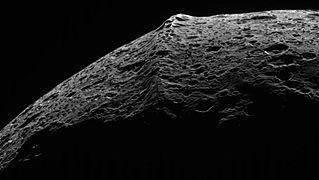
Cassini image of Iapetus's equatorial ridge

Voyager 1 photo of Io's highest peak, Boösaule Montes "South"

Ascraeus Mons (THEMIS IR with MOLA altimetry, 3x vertical stretch), Mars

Io's Euboea Montes (below top left), Haemus Montes (lower right); north is left

Mauna Kea (from Mauna Loa), Hawaii
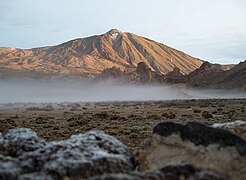
Teide, Canary Islands
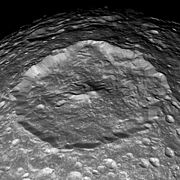
Cassini photo of Herschel crater on Mimas and its central peak

Magellan SAR image of Skadi Mons in Venus's Maxwell Montes

Denali (Mount McKinley), Alaska

Aeolis Mons ("Mount Sharp"), Mars (as viewed by the rover Curiosity on 6 August 2012).
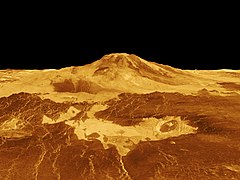
Maat Mons, Venus (radar imaging plus altimetry, 10x vertical exaggeration)
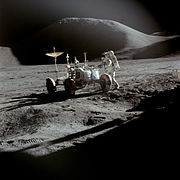
The Moon's Mons Hadley, near the Apollo 15 landing site (1971)
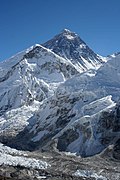
Mount Everest (Sagarmāthā/ Chomolungma), Nepal/Tibet
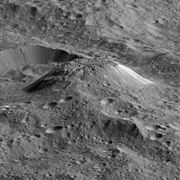
Ahuna Mons on Ceres, imaged by Dawn from LAMO

Pluto's possible cryovolcano Wright Mons, showing its central depression

New Horizons view of Pluto's Tenzing Montes in the left foreground (also in preceding image) and Hillary Montes on the horizon

Cassini SAR image of Titan's Mithrim Montes, showing three parallel ridges

Radar-generated view of Titan's cryovolcanic Doom Mons and Sotra Patera (10x vertical stretch)
| This article uses material from the Wikipedia article Metasyntactic variable, which is released under the Creative Commons Attribution-ShareAlike 3.0 Unported License. |