Solnhofen Limestone
TheSolnhofen Plattenkalk, orSolnhofen Limestone, geologically known as theAltmühltal Formation, is aJurassicKonservat-Lagerstättethat preserves a rare assemblage offossilizedorganisms, including highly detailed imprints of soft bodied organisms such as sea jellies. The most familiar fossils of the Solnhofen Plattenkalk include the early featheredtheropoddinosaurArchaeopteryxpreserved in such detail that they are among the most famous and most beautiful fossils in the world. The Solnhofen beds lie in theGermanstate ofBavaria (Bayern), halfway betweenNuremberg (Nürnberg)andMunich (München)and were originally quarried as a source oflithographic limestone. TheJura Museumsituated inEichstätt,Germanyhas an extensive exhibit ofJurassicfossils from the quarries of Solnhofen and surroundings, including marine reptiles,pterosaurs, and one specimen of the early birdArchaeopteryx.
| Altmühltal Formation Stratigraphic range: Tithonian PreꞒ Ꞓ O S D C P T J K Pg N | |
|---|---|
 Outcrop of the Solnhofen Limestone | |
| Type | Geological formation |
| Underlies | Mornsheim Formation |
| Overlies | Rögling Formation |
| Lithology | |
| Primary | Lithographic limestone |
| Location | |
| Coordinates | 48.9000°N 11.0000°E |
| Approximate paleocoordinates | 40.1°N 19.2°E |
| Region |  Bavaria Bavaria |
| Country |  Germany Germany |
| Type section | |
| Named for | Solnhofen |
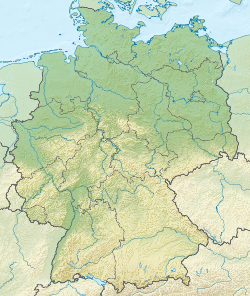  Solnhofen Limestone (Germany) |
Paleoenvironment and preservation

During the Late Jurassic, this area was an archipelago at the edge of the Tethys Sea. This included placid lagoons that had limited access to the open sea and where salinity rose high enough that the resulting brine could not support life. Since the lowest water was devoid of oxygen, many ordinary scavengers were absent. Any organism that fell, drifted, or was washed into the lagoons from the ocean or the land became buried in soft carbonate mud. Thus, many delicate creatures avoided consumption by scavengers or being torn apart by currents. The wings of dragonflies, the imprints of stray feathers, and terrestrial plants that washed into the lagoons were all preserved. The fossils are not numerous, but some of them are spectacular, and their range gives a comprehensive picture of a local Jurassic ecosystem.
At times, the lagoons almost dried out, exposing sticky carbonate muds that trapped insects and a few small dinosaurs. Over 600 species have been identified, including twenty-nine kinds of pterosaur ranging from the size of a sparrow to 1.2 m (4 ft) in length.
The fine-grained texture of the mud silt forming the limestone from the Solnhofen area (which is composed mainly of the towns of Solnhofen and Eichstätt) is ideal for making lithographic plates, and extensive quarrying in the 19th century revealed many fossil finds, as commemorated in the name Archaeopteryx lithographica, all the specimens of which come from these deposits. The closest modern analogue to the Solnhofen conditions is said to be Orca Basin in the northern Gulf of Mexico, though that area is much deeper than the Solnhofen lagoons.
Paleobiota
Significant members of the Solnhofen paleofauna include Archaeopteryx, pterosaurs, and marine invertebrates.
Cultural goods made from Solnhofen Plattenkalk

Adam and Eve (Fall of Man), 1514 by Ludwig Krug, Bode-Museum Berlin

Garden of Love/Fountain of Youth, 1525 by Loy Hering (Bode-Museum Berlin)
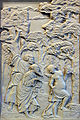
Susannah and the Elders, 1530 by Victor Kayser (Bode-Museum Berlin)

Salome Receives the Head of St. John the Baptist in the Dungeon, 1648 by Georg Schweigger
| This article uses material from the Wikipedia article Metasyntactic variable, which is released under the Creative Commons Attribution-ShareAlike 3.0 Unported License. |