Volcanic glass
Volcanic glassis theamorphous(uncrystallized) product of rapidly coolingmagma. Like all types ofglass, it is astate of matterintermediate between the close-packed, highly ordered array of a crystal and the highly disordered array of gas.Volcanic glass can refer to the interstitial, ormatrix, material in anaphanitic(fine grained) volcanic rock or can refer to any of several types of vitreousigneous rocks. Most commonly, it refers toobsidian, arhyoliticglass with highsilica(SiO2) content.
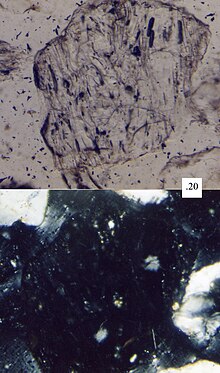
A sand grain of volcanic glass under the petrographic microscope. Its amorphous nature makes it disappear in cross-polarized light (bottom frame). Scale box in millimeters.
Other types of volcanic glass include:
- Pumice, which is considered a glass because it has no crystal structure.
- Apache tears, a kind of nodular obsidian.
- Tachylite (also spelled tachylyte), a basaltic glass with relatively low silica content.
- Sideromelane, a less common form of tachylyte.
- Palagonite, a basaltic glass with relatively low silica content.
- Hyaloclastite, a hydrated tuff-like breccia of sideromelane and palagonite.
- Pele's hair, threads or fibers of volcanic glass, usually basaltic.
- Pele's tears, tear-like drops of volcanic glass, usually basaltic.
- Limu o Pele (Pele's seaweed), thin sheets and flakes of brownish-green to near-clear volcanic glass, usually basaltic.
| This article uses material from the Wikipedia article Metasyntactic variable, which is released under the Creative Commons Attribution-ShareAlike 3.0 Unported License. |